Wednesday, November 7, 2007

Opportunities through Adversity

Below is an article from the Clay News
Commentary- Adversity Written by Richard Reynolds- CCHS teacher One Step Forward Adversity has become a buzz word in the Sports world today. Listen to any broadcaster, sports talk show or coach for any length of time and eventually you will hear how the word "adversity." A few years ago when Kevin Winslow was playing for the University of Miami and used the analogy of the football game being like "going to war" he was ridiculed by individuals in the media from every segment of the country from coast to coast. Yet we hear how a team learned about adversity by coming back from being two touchdowns down in the forth quarter. When the Boston Red Sox were down and trailing the Cleveland Indians recently many of the talk shows mentioned that they overcame "adversity" and therefore learned character which gives them an advantage in the World Series. Listen to ESPN, CBS, FOX or local radio talk show host and you will hear this word being used in relationship to something happening during a game. Cries should cry out from shore to shore that this is not adversity. This is a perversion of the word. Adversity is not starting out the season losing or not running for a hundred yards in a game with the San Diego Chargers, but it is waking up and being evacuated from your home because of a wild fire that is out of control. Real adversity is the Tight End recently injured for the Buffalo Bills that is dealing with the possibility of not being able to ever walk again after an injury during a recent game. Adversity is not Kurt Schilling dealing with a bloody sock in a World Series or any other numerous Sports events that are now related to the word even to the point that is becoming synonymous with the word! Adversity is known by the woman and her family that is in the process of fighting breast cancer. Adversity is known by the family that is learning first hand this year what the word "downsize" means because after many years of productive service to a company now a steady paycheck has become a distant memory. Adversity is the mother attempting to raise a family when the father has decided that he really only wanted to donate a chromosome and now does not want to do the rest that goes along with what it takes to go from fathering to being a "dad". Adversity is known by the Parents sitting in Children’s Hospital knowing that no matter how much they would like to help their child overcome their sickness that they are absolutely helpless and all they can do is to stand by watching and praying. As the Baseball season comes to an end with the World Series and Football is beginning to get to the series time of the BCS, high school play offs and the professional teams are beginning to say that every game is critical realize that adversity when correctly used is so much more than a sporting event. During this time of the year is when we turn to think of the holidays and we should think of those who are truly experiencing the harshness of adversity of life every day. Then get your class at school, your civic organization, your church or as an individual to becoming involved during this holiday season in helping making someone’s adversity that they are experiencing being just a little bit less. Help make the day of a widow…become a Big Brother/Big Sister…give a helping hand to someone out of work…being willing to help a class at a local school even though you do not have a child or all your children are grown…in some way or another dedicate yourself to opening your eyes to noticing true cases of adversity and becoming a person that is willing to do something about the adversity that people in our community are experiencing. Even though we have a great community, there are always people that are experiencing adversity. If Auburn or Alabama was down two touchdowns any Saturday, we would want them to overcome adversity and win. We should be that passionate about helping the members of our community this Holiday season and around the year in overcoming the true adversity of life.

Monday, November 5, 2007

Enthusiasm?

Add to Technorati FavoritesNothing is so contagious as enthusiasm." --Samuel Taylor Coleridge,English poet, critic and philosopher

Jump Start.org Tips

Add to Technorati FavoritesHow much time is appropriate to play computer games even if they are educational? Experts agree that young children should benefit from a variety of experiences such as physical activity and imaginative play. Computer games, video games and television can all be fun and educational for young children, but should be used wisely so they don't take too much time away from other important activities. All of these activities are more meaningful for children if there is sharing and discussion involved. Although computer games can be played independently, parental involvement makes learning more powerful; imagination and play more fun.As a guideline, children can use the computer to play and learn twice a week at 20 to 30 minutes each session. Of course, when a computer game is first introduced, children may want to play more. They can benefit from the learning and imaginative game play when they play games with friends and family!

Jump Start.org Tips

Add to Technorati FavoritesWhat is the best way to help a good reader master the confusion they have with b's and d's? Here are some suggestions that approach the challenge of differentiating b from d in different ways: Practice the difference between the letters in a physical game. Let your child practice these letters by writing with their finger tips on different surfaces. Cover a counter top with whipped cream or chocolate pudding. Demonstrate the letters and let the child practice to their hearts content. Give your child a visual cue for each letter. The b can be drawn as a bat with a ball next to it. The d can be drawn as a dog with a tail. This visual will help your child to remember the shape of each letter and be connected to a picture that uses its sound. Play with sounds and hear the differences between the two letters. We recommend using the Letter Book inside My Cabin in JumpStart World. Your child can turn to any letter page and experience the letters by listening to the letter sounds, hearing the sounds in alliterative songs, recording the sounds and songs with their own voices, and finally decorating a letter page with stickers of words that all start with that beginning sound. Make a letter collage by finding pictures of words that start with the sound b or d. Draw the shape of the letter on a large sheet of paper. Then help your child find as many examples of words beginning with the sound as possible and paste them onto the letter collage. Hang the picture on the wall as a reward and a reminder. These ideas work for learning all letters and sounds, and especially the letters that look alike!

Parenting Tips that are chances for learning

Add to Technorati Favorites Top Parent Tips Weighty IssuesThe next time you bring home groceries, help your child compare the weights of different items. For example, have your child hold a can of baked beans in one hand and a box of taco shells in the other. Which is heavier? Which is lighter? Is the heavier item always the larger item? Topsy-TurvyDraw these images on squares of paper: E, L, 3, J, >, K, /, P. Repeat so that there are two of each. Let your child put the images in a sack, shake the sack, and then remove the images. Can your child find the image pairs and rotate them so that they look exactly the same? (To simplify the activity, use only a few images at a time.) Name a NumberAsk your child to name a number between 1 and 6. Give your child that number of pennies. Repeat the activity, but this time, give your child nickels. Can your child count out all the pennies and nickels and tell you the total value? Triple TossMake a score sheet by writing the numbers 3 through 18 down the side of a sheet of paper. Then take turns with your child tossing three dice and adding. Initial the answer on the score sheet (unless it has already been initialed). Who can initial the most answers? Guess the CategoryName different items of clothing, continuing until your child can guess the category. Repeat the activity, but this time name items from a different category: furniture, fruits, vegetables, animals, rooms, plants, or things that use electricity.

What you can do for your student this week!

Add to Technorati FavoritesI am out Monday....but the show must still go on! The students will be exposed for the first time to new words that have to do with what they might see on a job application. Yes, these are vocabulary words that we will use in many different ways this week! Practice this week getting your child to know these words and the basic information that goes along with the information! It is a must for their success in the world outside of the home and the school! Here are some of the words~
  1. Social Security
  2. Birth Date
  3. Address
  4. First, Last and Middle Name
  5. School
  6. Phone
  7. Reference
  8. Training
  9. Experience
  10. Email
  11. Hours Available
  12. Hobbies
  13. Skills
  14. Who to call in case of an emergency

Our job is to not only give knowledge and help with the obtaining of knowledge but to help the students to be able to have the best opportunity possible to be a productive citizen after their school days...to do this we can not just teach words, and concepts that are "nice to know" but we strive to teach things that can be used in daily life situations! With your help that can become a reality...by ourself we can not accomplish all that needs to be taught but as a team we can see the needs of each student met!

Friday, November 2, 2007

Helping Students Learn at Home and at School

Add to Technorati Favorites In This Class, Math Comes With Music By Michael Alison ChandlerWashington Post Staff WriterTuesday, October 23, 2007; B01 The red plastic ON AIR sign is always lit in Eric Chandler's second-grade class, where a simple question about subtraction could elicit a rock performance styled after the Red Hot Chili Peppers. You say the bigger number and count backwards/Or say the smaller number, then count forwards/Just say one, count the other on your finger/Where you stop's the answer, now let's sing . . . Take it away, take it away, take it away now. The Loudoun County teacher writes his own songs and also adapts the lyrics of popular tunes. Some musicians find inspiration in love or nature, but Chandler finds it in the Virginia Standards of Learning. The right combination of chords and rhythm, he says, makes the state's curriculum more fun and more memorable. "A song, if it's catchy enough, gets stuck in your head," Chandler said. So he embeds lessons in verses that kids might hum one day when sitting for a test. For years, researchers have studied whether music education raises IQ points, test scores, spatial sense or math and verbal skills. Definitive results are scarce, but experts agree that music sparks the memory. "Just think of the alphabet song," said Ellen Winner, a Boston College psychology professor who studies how music education affects learning. As formal music instruction is getting squeezed in many schools to make room for math, reading and testing, more teachers are looking for new ways to add melody or syncopation to the daily classroom diet of worksheets and more worksheets. In the past three years, nearly 200 artists have contributed to a Michigan-based Web site, http://songsforteaching.com/, that offers music for core subjects, foreign languages, special education and classroom management. Other Web sites specialize in math or science songs. A national Science Songwriters' Association sells independently produced albums, including some with Washington-area connections. Most educational songwriters sell online or at teaching conferences, having found it hard to get their songs on shelves in music stores. The Chromatics, an a cappella group of mostly research scientists based in Greenbelt, has sold nearly 15,000 copies of its educational astronomy albums in those ways. "We wanted to be the 'Schoolhouse Rock!' of astronomy," said singer Padi Boyd, saying she remembers many of the grammar- and history-based jingles from the educational films that aired between cartoons in the 1970s and '80s. Boyd's group used national science curriculum standards to write songs about the sun, planets and sound waves. Chandler recently finished an album of songs about spelling, including "Short Vowel Rock." His greatest math hits include "Fact Family," set to the tune of "We Are Family" by Sister Sledge, and his own "Addend Plus Addend." After a decade teaching first grade, Chandler moved to second grade this year at Mountain View Elementary School in Purcellville, providing another set of grade-level state standards to dive into. Eventually he wants to cut an album for each elementary grade and sell them statewide. Chandler, 33, embraced musical pedagogy after learning about a teaching method called Quantum Learning, which encourages using music to keep students engaged and focused. Now Chandler is more likely to reach for his acoustic guitar than a dry-erase marker when explaining something complex. He even starts off the day with song. One recent morning, students were quietly reading "The Ralph Mouse Collection" and "Froggy Goes to School" when the first beats of C+C Music Factory's "Everybody Dance Now" thumped from a boombox. Josh Smith pumped his fists in the air, and Matthew Hudler struck a pose. Chandler, and then his students, started clapping in time. With one final big clap, the room went quiet. First lesson? Geography. Chandler strapped on his guitar. I live in Purcellville/I live in Loudoun County/I live in Virginia/I live in the United States of America/I live in North America/I live on Planet Earth/I live in the Solar System/I live inside of the Milky Way/How can anyone live in all these places?/Sometimes it is hard to understand. They sang another song called "Objects Move" for a science lesson. They also sang along in a rousing, Johnny Cash-like version of "That Shiny Nickel," with a count-by-fives chorus. Chandler finished with nimble riffs on the guitar, moving his fingers fret by fret until the children applauded. Sophia Sgarrella, with two long braids, called out from her desk, "You're going to break your pick someday." "Thank you, thank you very much," he said, Elvis-like at the mike. Chandler said his songwriting has evolved. He called his early attempts too singsong. "Kids don't go around singing nursery rhymes," he said. "They are into popular music. First- and second-graders, they listen to the radio." Now his subtraction rocks. For more edge, he obtained a grant to purchase his own portable studio, including a microphone, electric drum set and recording equipment. He collaborated with a technology teacher at his school to make slide shows or music videos of his songs, many of which have been posted on the school system's server for other teachers to use. Special requests have started coming from colleagues. Chandler wrote a fourth-grade song about Virginia's Native American tribes and a rap about Virginia "Document Dudes," also known as the Founding Fathers, who penned such works as the Constitution. Though his customer base is growing, he already has adoring fans, and possibly future musicians, in his class. Chandler said that after winter break each year, a handful of students come in with new guitars and want to learn the class tunes. Others are happy just to sing along. "There's only one teacher in the whole school who plays guitar," Sophia bragged after a morning of musical lessons. "And I'm looking at him." © 2007 The Washington Post Company

Providing New Opportunities Requires New Ways of Thinking

The rules of cycling also apply to life. Take care of yourself. Set goals. Learn from the experts. Share your wisdom. Be prepared." --Karen Bliss Livingston,Olympic cyclist
Add to Technorati Favorites Published Online: October 26, 2007 Commentary Shift Happens Four crazy ideas that might burst the modern education paradigm. By Mark Weston Evidence suggests that our modern education paradigm, which does a terrific job of educating some students to high levels of learning, may be incapable of educating all students to equally high levels. Moreover, its inability to silence critics, support normal practice, and educate all the students persists despite efforts to the contrary. Have we reached a point where a new insight or fresh perspective might burst the old paradigm? Sound crazy? Consider three such insights from the past that contributed to much broader changes in the world. One insight, Benjamin Franklin’s idea for an American census, revealed that a few thousand British soldiers could not keep millions of colonists in line. It changed the way colonists saw their relationship with Britain and fomented a revolution. Another, Gandhi’s admonition that the peoples of India be “the change you wish to see in the world,” led to an unprecedented, nonviolent shift of power. In a third instance, Einstein’s insights into Newtonian physics demonstrated that space-time is one dimension, not two, which led to a range of new ideas, theories, and questions. In each case, a fresh perspective fueled a paradigm shift. Are there insights whose time may have arrived that would cause us to quit propping up the existing educational paradigm—with more money, more people, more everything—in favor of an alternative? Here are four present-day educational issues, each with a possibly paradigm-bursting twist. Increasing high-school-completion rates has been a goal of nearly every effort to improve education of the past three decades. What would happen if every child who is entitled to attend school, but not currently enrolled—about 30 percent of the school-age population—returned to school? Could the existing facilities accommodate the surge in students? Would instructors have the capacity to meet these students’ educational needs? Could the safety-net programs prevent them from falling through the cracks again? Would “adequate yearly progress” be attainable with so many more students attending school? Could class-size requirements be met? While all students may know that they have the right to attend school, few know that by simply doing so they might change the education system forever. If feedback from all stakeholders drove educational decisions, the nature of the conversation would certainly change, quite possibly for the better. When parents are engaged in their children’s schooling, students do better. Not surprisingly, getting parents engaged has been another widely embraced goal. With most homes and classrooms connected to the Internet, one form of engagement that warrants a deeper look is the use of e-mail. Infrequent—weekly, monthly, quarterly—now characterizes the e-mail exchanges between educators and parents. What would happen if every teacher and parent exchanged one e-mail per day, perhaps about a lesson that day and one for the next? With nearly $7 billion spent annually for educational technology, this is not an outlandish expectation. What would be outlandish is this once-a-day exchange causing havoc to the technological infrastructure of most schools. How confident are we that the system could handle the load? Would teachers have time to manage the e-mails? And if neither teachers nor infrastructure can handle an extra set of e-mails each day, then what makes us think more complex practices would be possible? In short, while engaging parents is the right thing to do, it is not clear that the current education system could withstand the consequences of that actually happening. Most everyone agrees that feedback about performance is an essential ingredient for improving instructional practice, student achievement, and management of limited resources. Not surprisingly, nowadays data-driven decisionmaking is in vogue. What would happen if we brought the feedback loop used in the current paradigm—instructors and administrators evaluating students via formal assessments, portfolios, quizzes, and tests and parents voting on the school board’s makeup—full circle? What if, that is, students provided feedback about the performance of their instructors, instructors about administrators, instructors about parents, and parents about instructors and administrators. Would student learning increase? Would instruction improve? Would parent engagement increase? If feedback from all stakeholders drove educational decisions, the nature of the conversation would certainly change, quite possibly for the better. School buildings throughout America—particularly those in urban areas—are in a state of decay. What would happen if, instead of simply viewing schooling as a place where students go to learn, with buildings to be repaired or replaced, we viewed school as a process through which students gained skills and acquired knowledge? Would giving computing devices to students spark the shift from place to process? Would doing so reduce the need for computer labs and classrooms? Would focusing on process lead to a learning day that produced greater achievement gains than a school day? Crazy ideas? Indeed. The insights of Franklin, Gandhi, and Einstein in their eras were undoubtedly viewed as equally crazy, and look what changes they wrought. So while the insights posited here raise the possibility that getting what we want—higher school-completion rates, engaged parents, data-driven decisions, and school building replacements—could lead to chaos, they also might set the stage for a paradigm shift that results in all children getting the education they deserve. Mark Weston, an education reformer and researcher living in Atlanta, is investigating the shifting educational paradigm in America. He can be reached at mkweston@comcast.net. Vol. 27 from Education Week

Thursday, November 1, 2007

Bowling Opportunities from today!

This class is about providing opportunities! Today we took the class to Trussville to the newest bowling alley in the area called "Lightening Strikes". Personnel Manager Bill Hyde made us extremely comfortable and went out of his way along with his staff to make sure we had a great time! The students learned about bowling but also about working together, how to have fun and how to get along with each other even though they are in competition! What can you do to provide an opportunity for someone this week?
Add to Technorati Favorites

Tuesday, October 30, 2007

Leading that provides more opportunities

Add to Technorati FavoritesOctober 19, 2007 Leading from Second Chair Back in September, Teachers as Leaders spurred some deep discussion about school roles. Today, ASCD author Pam Robbins asked attendees at her session on the assistant principalship, Which leadership actions do you believe are most essential to fostering staff and student learning? Here's what a room full of mostly education administrators had to say: "Be available." "Lead from the middle. If you’re in among people and you’re willing to roll up your sleeves, you earn respect instead of demanding it. Don’t ask people to do anything you’re not willing to do.” "In San Jose, all principals, assistant principals, and deans also teach, and that creates a lot of collegiality among administrators and teachers." "Even if you're not teaching classes, be willing to be in the classroom, because we were all in the classroom at one point." "Since I'm here today, I have a teacher back at my school that's subbing for me. I think it's important to let teachers try on some of the administrator's responsibilites, as well." "We need to allocate the resources that allow teachers to be as effective as possible." What leadership actions are most significant to you? Pam Robbins, author of The New Principal's Fieldbook: Strategies for Success, presented a session titled The Quiet Journey to Excellence: Success Strategies of Assistant Principals. Visit Inservice throughout the weekend for more coverage of ASCD's 2007 Conference on Teaching & Learning in Atlanta. Posted by Laura Varlas in Conference on Teaching and Learning Digg This Save to del.icio.us

To praise or not to praise is the question...?

Add to Technorati FavoritesIntellectual growth should commence at birth and cease only at death!-Albert Einstein October 2007 October 2007 Volume 65 Number 2Early Intervention at Every Age Pages 34-39 The Perils and Promises of Praise Carol S. Dweck The wrong kind of praise creates self-defeating behavior. The right kind motivates students to learn. We often hear these days that we've produced a generation of young people who can't get through the day without an award. They expect success because they're special, not because they've worked hard. Is this true? Have we inadvertently done something to hold back our students? I think educators commonly hold two beliefs that do just that. Many believe that (1) praising students' intelligence builds their confidence and motivation to learn, and (2) students' inherent intelligence is the major cause of their achievement in school. Our research has shown that the first belief is false and that the second can be harmful—even for the most competent students. As a psychologist, I have studied student motivation for more than 35 years. My graduate students and I have looked at thousands of children, asking why some enjoy learning, even when it's hard, and why they are resilient in the face of obstacles. We have learned a great deal. Research shows us how to praise students in ways that yield motivation and resilience. In addition, specific interventions can reverse a student's slide into failure during the vulnerable period of adolescence. Fixed or Malleable? Praise is intricately connected to how students view their intelligence. Some students believe that their intellectual ability is a fixed trait. They have a certain amount of intelligence, and that's that. Students with this fixed mind-set become excessively concerned with how smart they are, seeking tasks that will prove their intelligence and avoiding ones that might not (Dweck, 1999, 2006). The desire to learn takes a backseat. Other students believe that their intellectual ability is something they can develop through effort and education. They don't necessarily believe that anyone can become an Einstein or a Mozart, but they do understand that even Einstein and Mozart had to put in years of effort to become who they were. When students believe that they can develop their intelligence, they focus on doing just that. Not worrying about how smart they will appear, they take on challenges and stick to them (Dweck, 1999, 2006). More and more research in psychology and neuroscience supports the growth mind-set. We are discovering that the brain has more plasticity over time than we ever imagined (Doidge, 2007); that fundamental aspects of intelligence can be enhanced through learning (Sternberg, 2005); and that dedication and persistence in the face of obstacles are key ingredients in outstanding achievement (Ericsson, Charness, Feltovich, & Hoffman, 2006). Alfred Binet (1909/1973), the inventor of the IQ test, had a strong growth mind-set. He believed that education could transform the basic capacity to learn. Far from intending to measure fixed intelligence, he meant his test to be a tool for identifying students who were not profiting from the public school curriculum so that other courses of study could be devised to foster their intellectual growth. The Two Faces of Effort The fixed and growth mind-sets create two different psychological worlds. In the fixed mind-set, students care first and foremost about how they'll be judged: smart or not smart. Repeatedly, students with this mind-set reject opportunities to learn if they might make mistakes (Hong, Chiu, Dweck, Lin, & Wan, 1999; Mueller & Dweck, 1998). When they do make mistakes or reveal deficiencies, rather than correct them, they try to hide them (Nussbaum & Dweck, 2007). They are also afraid of effort because effort makes them feel dumb. They believe that if you have the ability, you shouldn't need effort (Blackwell, Trzesniewski, & Dweck, 2007), that ability should bring success all by itself. This is one of the worst beliefs that students can hold. It can cause many bright students to stop working in school when the curriculum becomes challenging. Finally, students in the fixed mind-set don't recover well from setbacks. When they hit a setback in school, they decrease their efforts and consider cheating (Blackwell et al., 2007). The idea of fixed intelligence does not offer them viable ways to improve. Let's get inside the head of a student with a fixed mind-set as he sits in his classroom, confronted with algebra for the first time. Up until then, he has breezed through math. Even when he barely paid attention in class and skimped on his homework, he always got As. But this is different. It's hard. The student feels anxious and thinks, “What if I'm not as good at math as I thought? What if other kids understand it and I don't?” At some level, he realizes that he has two choices: try hard, or turn off. His interest in math begins to wane, and his attention wanders. He tells himself, “Who cares about this stuff? It's for nerds. I could do it if I wanted to, but it's so boring. You don't see CEOs and sports stars solving for x and y.” By contrast, in the growth mind-set, students care about learning. When they make a mistake or exhibit a deficiency, they correct it (Blackwell et al., 2007; Nussbaum & Dweck, 2007). For them, effort is a positive thing: It ignites their intelligence and causes it to grow. In the face of failure, these students escalate their efforts and look for new learning strategies. Let's look at another student—one who has a growth mind-set—having her first encounter with algebra. She finds it new, hard, and confusing, unlike anything else she has ever learned. But she's determined to understand it. She listens to everything the teacher says, asks the teacher questions after class, and takes her textbook home and reads the chapter over twice. As she begins to get it, she feels exhilarated. A new world of math opens up for her. It is not surprising, then, that when we have followed students over challenging school transitions or courses, we find that those with growth mind-sets outperform their classmates with fixed mind-sets—even when they entered with equal skills and knowledge. A growth mind-set fosters the growth of ability over time (Blackwell et al., 2007; Mangels, Butterfield, Lamb, Good, & Dweck, 2006; see also Grant & Dweck, 2003). The Effects of Praise Many educators have hoped to maximize students' confidence in their abilities, their enjoyment of learning, and their ability to thrive in school by praising their intelligence. We've studied the effects of this kind of praise in children as young as 4 years old and as old as adolescence, in students in inner-city and rural settings, and in students of different ethnicities—and we've consistently found the same thing (Cimpian, Arce, Markman, & Dweck, 2007; Kamins & Dweck, 1999; Mueller & Dweck, 1998): Praising students' intelligence gives them a short burst of pride, followed by a long string of negative consequences. In many of our studies (see Mueller & Dweck, 1998), 5th grade students worked on a task, and after the first set of problems, the teacher praised some of them for their intelligence (“You must be smart at these problems”) and others for their effort (“You must have worked hard at these problems”). We then assessed the students' mind-sets. In one study, we asked students to agree or disagree with mind-set statements, such as, “Your intelligence is something basic about you that you can't really change.” Students praised for intelligence agreed with statements like these more than students praised for effort did. In another study, we asked students to define intelligence. Students praised for intelligence made significantly more references to innate, fixed capacity, whereas the students praised for effort made more references to skills, knowledge, and areas they could change through effort and learning. Thus, we found that praise for intelligence tended to put students in a fixed mind-set (intelligence is fixed, and you have it), whereas praise for effort tended to put them in a growth mind-set (you're developing these skills because you're working hard). We then offered students a chance to work on either a challenging task that they could learn from or an easy one that ensured error-free performance. Most of those praised for intelligence wanted the easy task, whereas most of those praised for effort wanted the challenging task and the opportunity to learn. Next, the students worked on some challenging problems. As a group, students who had been praised for their intelligence lost their confidence in their ability and their enjoyment of the task as soon as they began to struggle with the problem. If success meant they were smart, then struggling meant they were not. The whole point of intelligence praise is to boost confidence and motivation, but both were gone in a flash. Only the effort-praised kids remained, on the whole, confident and eager. When the problems were made somewhat easier again, students praised for intelligence did poorly, having lost their confidence and motivation. As a group, they did worse than they had done initially on these same types of problems. The students praised for effort showed excellent performance and continued to improve. Finally, when asked to report their scores (anonymously), almost 40 percent of the intelligence-praised students lied. Apparently, their egos were so wrapped up in their performance that they couldn't admit mistakes. Only about 10 percent of the effort-praised students saw fit to falsify their results. Praising students for their intelligence, then, hands them not motivation and resilience but a fixed mind-set with all its vulnerability. In contrast, effort or “process” praise (praise for engagement, perseverance, strategies, improvement, and the like) fosters hardy motivation. It tells students what they've done to be successful and what they need to do to be successful again in the future. Process praise sounds like this: You really studied for your English test, and your improvement shows it. You read the material over several times, outlined it, and tested yourself on it. That really worked! I like the way you tried all kinds of strategies on that math problem until you finally got it. It was a long, hard assignment, but you stuck to it and got it done. You stayed at your desk, kept up your concentration, and kept working. That's great! I like that you took on that challenging project for your science class. It will take a lot of work—doing the research, designing the machine, buying the parts, and building it. You're going to learn a lot of great things. What about a student who gets an A without trying? I would say, “All right, that was too easy for you. Let's do something more challenging that you can learn from.” We don't want to make something done quickly and easily the basis for our admiration. What about a student who works hard and doesn't do well? I would say, “I liked the effort you put in. Let's work together some more and figure out what you don't understand.” Process praise keeps students focused, not on something called ability that they may or may not have and that magically creates success or failure, but on processes they can all engage in to learn. Motivated to Learn Finding that a growth mind-set creates motivation and resilience—and leads to higher achievement—we sought to develop an intervention that would teach this mind-set to students. We decided to aim our intervention at students who were making the transition to 7th grade because this is a time of great vulnerability. School often gets more difficult in 7th grade, grading becomes more stringent, and the environment becomes more impersonal. Many students take stock of themselves and their intellectual abilities at this time and decide whether they want to be involved with school. Not surprisingly, it is often a time of disengagement and plunging achievement. We performed our intervention in a New York City junior high school in which many students were struggling with the transition and were showing plummeting grades. If students learned a growth mind-set, we reasoned, they might be able to meet this challenge with increased, rather than decreased, effort. We therefore developed an eight-session workshop in which both the control group and the growth-mind-set group learned study skills, time management techniques, and memory strategies (Blackwell et al., 2007). However, in the growth-mind-set intervention, students also learned about their brains and what they could do to make their intelligence grow. They learned that the brain is like a muscle—the more they exercise it, the stronger it becomes. They learned that every time they try hard and learn something new, their brain forms new connections that, over time, make them smarter. They learned that intellectual development is not the natural unfolding of intelligence, but rather the formation of new connections brought about through effort and learning. Students were riveted by this information. The idea that their intellectual growth was largely in their hands fascinated them. In fact, even the most disruptive students suddenly sat still and took notice, with the most unruly boy of the lot looking up at us and saying, “You mean I don't have to be dumb?” Indeed, the growth-mind-set message appeared to unleash students' motivation. Although both groups had experienced a steep decline in their math grades during their first months of junior high, those receiving the growth-mind-set intervention showed a significant rebound. Their math grades improved. Those in the control group, despite their excellent study skills intervention, continued their decline. What's more, the teachers—who were unaware that the intervention workshops differed—singled out three times as many students in the growth-mindset intervention as showing marked changes in motivation. These students had a heightened desire to work hard and learn. One striking example was the boy who thought he was dumb. Before this experience, he had never put in any extra effort and often didn't turn his homework in on time. As a result of the training, he worked for hours one evening to finish an assignment early so that his teacher could review it and give him a chance to revise it. He earned a B+ on the assignment (he had been getting Cs and lower previously). Other researchers have obtained similar findings with a growth-mind-set intervention. Working with junior high school students, Good, Aronson, and Inzlicht (2003) found an increase in math and English achievement test scores; working with college students, Aronson, Fried, and Good (2002) found an increase in students' valuing of academics, their enjoyment of schoolwork, and their grade point averages. To facilitate delivery of the growth-mind-set workshop to students, we developed an interactive computer-based version of the intervention called Brainology. Students work through six modules, learning about the brain, visiting virtual brain labs, doing virtual brain experiments, seeing how the brain changes with learning, and learning how they can make their brains work better and grow smarter. We tested our initial version in 20 New York City schools, with encouraging results. Almost all students (anonymously polled) reported changes in their study habits and motivation to learn resulting directly from their learning of the growth mind-set. One student noted that as a result of the animation she had seen about the brain, she could actually “picture the neurons growing bigger as they make more connections.” One student referred to the value of effort: “If you do not give up and you keep studying, you can find your way through.” Adolescents often see school as a place where they perform for teachers who then judge them. The growth mind-set changes that perspective and makes school a place where students vigorously engage in learning for their own benefit. Going Forward Our research shows that educators cannot hand students confidence on a silver platter by praising their intelligence. Instead, we can help them gain the tools they need to maintain their confidence in learning by keeping them focused on the process of achievement. Maybe we have produced a generation of students who are more dependent, fragile, and entitled than previous generations. If so, it's time for us to adopt a growth mind-set and learn from our mistakes. It's time to deliver interventions that will truly boost students' motivation, resilience, and learning. References Aronson, J., Fried, C., & Good, C. (2002). Reducing the effects of stereotype threat on African American college students by shaping theories of intelligence. Journal of Experimental Social Psychology, 38, 113–125. Binet, A. (1909/1973). Les idées modernes sur les enfants [Modern ideas on children]. Paris: Flamarion. (Original work published 1909) Blackwell, L., Trzesniewski, K., & Dweck, C. S. (2007). Implicit theories of intelligence predict achievement across an adolescent transition: A longitudinal study and an intervention. Child Development, 78, 246–263. Cimpian, A., Arce, H., Markman, E. M., & Dweck, C. S. (2007). Subtle linguistic cues impact children's motivation. Psychological Science, 18, 314–316. Doidge, N. (2007). The brain that changes itself: Stories of personal triumph from the frontiers of brain science. New York: Viking. Dweck, C. S. (1999). Self-theories: Their role in motivation, personality and development. Philadelphia: Taylor and Francis/Psychology Press. Dweck, C. S. (2006). Mindset: The new psychology of success. New York: Random House. Ericsson, K. A., Charness, N., Feltovich, P. J., & Hoffman, R. R. (Eds.). (2006). The Cambridge handbook of expertise and expert performance. New York: Cambridge University Press. Good, C., Aronson, J., & Inzlicht, M. (2003). Improving adolescents' standardized test performance: An intervention to reduce the effects of stereotype threat. Journal of Applied Developmental Psychology, 24, 645–662. Grant, H., & Dweck, C. S. (2003). Clarifying achievement goals and their impact. Journal of Personality and Social Psychology, 85, 541–553. Hong, Y. Y., Chiu, C., Dweck, C. S., Lin, D., & Wan, W. (1999). Implicit theories, attributions, and coping: A meaning system approach. Journal of Personality and Social Psychology, 77, 588–599. Kamins, M., & Dweck, C. S. (1999). Person vs. process praise and criticism: Implications for contingent self-worth and coping. Developmental Psychology, 35, 835–847. Mangels, J. A., Butterfield, B., Lamb, J., Good, C. D., & Dweck, C. S. (2006). Why do beliefs about intelligence influence learning success? A social-cognitive-neuroscience model. Social, Cognitive, and Affective Neuroscience, 1, 75–86. Mueller, C. M., & Dweck, C. S. (1998). Intelligence praise can undermine motivation and performance. Journal of Personality and Social Psychology, 75, 33–52. Nussbaum, A. D., & Dweck, C. S. (2007). Defensiveness vs. remediation: Self-theories and modes of self-esteem maintenance. Personality and Social Psychology Bulletin. Sternberg, R. (2005). Intelligence, competence, and expertise. In A. Elliot & C. S. Dweck (Eds.), The handbook of competence and motivation (pp. 15–30). New York: Guilford Press. Carol S. Dweck is the Lewis and Virginia Eaton Professor of Psychology at Stanford University and the author of Mindset: The New Psychology of Success (Random House, 2006). -->--> Copyright © 2007 by Association for Supervision and Curriculum Development © Copyright ASCD. All rights reserved. _uacct = "UA-1303565-3"; urchinTracker();

Monday, October 29, 2007

An Idea but not an Endorsement

Add to Technorati Favorites Sylvan has a proven program to help your child achieve success in school. Sylvan can help with Reading, Math, Writing, Study Skills and more! And if you enroll in a personalized program you will save $300! You'll save $100 off your child's Sylvan Skills Assessment® plus $200 off tuition.* To learn more about Sylvan, visit http://tk.publicaster.com/DC/ctr.aspx?6C6164=393037383839&736272=268840&747970=6874&66=30 *Offer valid at participating locations only through 11/30/07. Discount does not apply to Homework Help, Camps or SAT/ACT Prep. Tuition credit of $200 will be issued upon completion of 36 hours of instruction. Valid for new enrollments only. Limit one per customer.

Hints to improve study time at home!

Add to Technorati Favorites 1. Establish a regular study time. Find a schedule that works for your child and your family, but avoid late-night study times. If the schedule varies from day to day because of extracurricular activities, write it out and post it prominently. 2. Be available during study time. Children like to have someone on hand who can answer questions if they come up. If no one is around to help your child, have him or her save questions for when you get home. 3. Look over completed assignments. Check each day to see that your child¹s homework has been completed. When your child¹s teacher returns completed assignments, look them over to see if your child is having any problems. 4. Figure out how your child learns best. Does he work better alone or with others? Does she learn more easily when she can see things, touch them, or hear them? Maybe you can help by finding a study group, by providing visual aids, or by reading materials and directions aloud. 5. Help your child prepare for tests. Review with your child what he needs to study for upcoming tests, and create a study schedule. Create a practice test you can give at home, and talk about test-taking skills such as making sure to read directions thoroughly.
______________________________ This is from an email I got from Knowledge Adventure.com. They have some of the best software for your children and I know that it would benefit them if you would work through it until they became comfortable with it . Notice the offer below! I get nothing from this monetarily except for the satisfaction of knowing that my students are making progress! http://www.knowledgeadventure.com/ *Offer only available online at Shop.KnowledgeAdventure.com. Free standard USPS shipping to continental US destinations. Free workbook available with each JumpStart World Starter Kit purchased. Cannot be combined with other offers. Offer expires 11/14/2007. Knowledge Adventure sent this e-mail to you because you signed up to receive the Knowledge Adventure e-Newsletter. Knowledge Adventure will not request personal data (password, credit card/bank numbers) in an e-mail.

We are educating in a changing world with changing values

Add to Technorati Favorites Saturday, Oct. 27, 2007Happiness is a conscious choice, not an automatic response." --Mildred Barthel, Teen Challenges Silence Law By AP/CARLA K. JOHNSON (Chicago) — A 14-year-old girl and her outspoken atheist father filed a federal lawsuit Friday challenging a new Illinois law requiring a brief period of prayer or reflective silence at the start of every school day. The lawsuit asks the court to declare the law unconstitutional, said attorney Gregory Kulis, who represents Dawn Sherman, a freshman at Buffalo Grove High School, and her father Robert Sherman, a radio talk show host. Kulis said the law is an attempt to inject religion into public schools in violation of the First Amendment. The suit also seeks a temporary restraining order to halt schools' obeying the law until the case is decided. A judge will consider that request at a hearing Monday. The lawsuit names Gov. Rod Blagojevich and officials of Township High School District 214 as defendants. School district spokeswoman Venetia Miles said schools will continue to comply with the law. Blagojevich spokesman Abby Ottenhoff said the law was passed over the governor's veto. "We don't believe requiring time for reflection is the role of government," Ottenhoff said. Sherman said he went to court after he asked the school board to ignore the law and was rebuffed. The school district informed him it would carry out the moment of silence during third period, beginning Tuesday, the lawsuit said. "What we object to is Christians passing a law that requires the public school teacher to stop teaching during instructional time, paid for by the taxpayers, so that Christians can pray," Sherman told The Associated Press. An Illinois law called the Silent Reflection and Student Prayer Act already allowed schools to observe a moment of silence if they wanted. A new measure changed just a single word: "may" observe became "shall" observe. The Illinois law originally passed during the spring legislative session, but Blagojevich vetoed it, saying he had doubts about its constitutionality. Lawmakers overrode the veto this month. It's not Sherman's first church-and-state lawsuit and not the first to involve his children. He has sought removal of religious symbols from city seals and a ban on Boy Scout meetings at public schools. Some school administrators have complained the law is too ill-defined and puts many teachers and some students in an awkward position. The Shermans may have legitimate concerns, but they are suing the wrong party when they target the school district, said Brian McCarthy, an attorney for the district. "The General Assembly — for better, worse, foolish or wise — passed this law and it's not up to school districts to pick and choose which laws they follow," McCarthy said. "He needs to go after the entity that enforces that law." http://www.time.com/time/nation/article/0,8599,1677066,00.html Copyright ? 2007 Time Inc. All rights reserved. Reproduction in whole or in part without permission is prohibited.

Technology used correctly is a great opportunity!

Many Parents fear the internet and technology when really with the needed safeguards implemented it can spur a student to heights never imagined. I can recommend software f0r practice in reading, writing and math which will not seem like homework but will increase over time your childs academic levels if they find that the computer is more than just a toy! Below is an article that reinforces this idea!
____________________________________
This is a printer friendly version of an article from hattiesburgamerican.com
Article published Oct 29, 2007
New technology helps students teach each other algebra
Special to the American POPLARVILLE - Imagine a seemingly endless supply of algebra problems. And an instantaneous explanation of why you got them wrong. It's not a nightmare but the latest way to learn and teach math: the Math Power Laboratory. "There is an increased community atmosphere gained in the lab," instructor Kelly Tucker said. "Students are discussing and teaching each other, and we all know the best way to learn is to teach." Pearl River Community College began using MyMathLab software in college algebra classes a year ago on the Poplarville campus. This year, it is being used in college and intermediate algebra classes in Poplarville and in college algebra classes at the Forrest County Center in Hattiesburg. "It helps you out a lot," said Laiken Swilley of Hattiesburg, who is taking intermediate algebra on the Poplarville campus. "It gives examples and helps you step-by-step all the way through." Feedback from students and teachers has been positive, said Jennifer Seal, director of the PRCC Quality Enhancement Plan. "It has allowed the instructors to provide more in-depth explanations of mathematical concepts and a wide variety of teaching tools to meet students' needs on a lot of different levels," she said. "As far as students are concerned, they're able to practice an unlimited number of problems. If they've missed a problem, they can see why they've missed it. It's immediate feedback." Instructors or student peers tutor students as they learn to use the program and the various tools it provides. The resources include a video on each topic, examples of every question, PowerPoint lectures and audio examples. The software lets students work homework problems until they are correct or until the student understands the concept. "Not having to address homework problems in class frees up so much more time," said instructor Jacki Runnels at the Forrest County Center. "I feel I can present the new information more thoroughly and the students have a better understanding of the topics prior to attempting the homework themselves." Math students are also using software that gives them real-world laboratory exercises, and the classrooms are equipped with an interactive whiteboard, wireless slate, wireless Internet access and an electronic document display unit. The interactive whiteboard technology allows instructors to post each day's notes onto the class Blackboard site and students can access and download the notes at their convenience. The technology allows students to listen and observe as the instructor teaches the concept and not be distracted by taking notes. "On their initial use, some students are resistant to using the technology," said Judy Roane, chair of the PRCC Science, Mathematics and Business Department. "But, after the first few homework assignments, students begin to realize the benefits of MyMathLab and their confidence in their ability to do mathematics increases. With increased confidence, students have a higher level of success." The Math Power Laboratories are open from 8 a.m. to 3 p.m. Monday-Friday on both the Poplarville and Hattiesburg campuses. Both have extended hours on some days, based on student need. Each lab contains 30 desktop computers and a laser printer and is staffed with an instructor, laboratory document assistant and student tutor.

Opportunities this week...

Words for this week:
  1. Monster
  2. Pumpkin
  3. Corn
  4. Dog
  5. Bowling
  6. Pin
  7. Lane
  8. Alley
  9. Ball
  10. Holes
  11. Costume
  12. Halloween
  13. October 31
  14. Dance
  15. Music
  16. Loud
  17. People
  18. Lassie
  19. Candy
  20. Sweets
  21. Food
  22. Trick
  23. Treat
  24. Roll
  25. Candy Bar

Remember that tommorrow is the Monster Mash! Don't forget if your student would like to dress up they can but it is not a requirement!

The above words have meanings that are part of every day things that we will be working on all of this week. I encourage you to print off the list and once a night at least to go over them with your child. You can ask them to use the words in a sentence and also tell you the meaning of them. By going over the words multiple times and connecting them will real events during the week there will be a great possibility of recall.

For the homework Packet this week I will be sending home reading logs and a book. When the book is finished send it back and I will send another home. Students at this age try to hide that they may not know a word. They will guess, skip over the word or substitute something else for it! That is why I encourage you to let you child read to you! Watch the words they read or they may be so good at hiding their difficulty in reading that you will not know that a word or even an entire sentence might have been skipped! On Friday send the reading log in so that I can see how much has been read. I ask for at least fifteen minutes a night to be read.

The bowling will need your permission slip and $6.00 sent in so that everything can be ready for Thursday. Please go ahead and send it in on Tuesday so that we can know everyone will be able to go!

Always bear in mind that your own resolution to succeed is more important than any one thing. Abraham Lincoln (1809 - 1865)

Friday, October 26, 2007

Providing Opportunities through getting the word spread far and wide about our progress

Jacket lets parents keep track of kids By KATE SCHUMAN, Associated Press WriterLONDON - Parents may worry less about losing their child - and the kid's expensive coat - with a new piece of winter wear that includes a global positioning tracker. The jackets, released this week by the British clothing company Bladerunner, have a GPS tracking device in the lining. The device can track the jacket anywhere in the world, within 43 square feet. "The jacket is not something that was released due to people losing their kids," said Adrian Davis, a partner at Bladerunner. "It was originally made for mountain climbers, skiers and snowboarders." Davis said the company decided to make a children's version of the jacket aimed at parents concerned about their children's safety. Using Google Earth maps, users can watch the jacket wearer move. The movements are updated every 10 seconds. But they don't need to be online to find out where the person is. Users can also receive alerts to their e-mail or cell phone when the jacket leaves the boundary, meaning parents could potentially receive alerts whenever their children skipped school, left the neighborhood or went to their boyfriend's house - so long as the child was wearing the jacket. Bladerunner, which designed the jacket and commissioned Asset Monitoring Solutions to craft the tracking device, made headlines in the spring when they released slash-resistant clothing for children, aimed at those worried about increasing knife crime in London. The new jacket is also equipped with the slash-resistant lining. The tracking device uses a rechargeable battery that can last for about 18 hours. A children's tracking jacket costs $500, plus $20 a month for the tracking technology. An adult jacket costs $700. All rights reserved. This copyrighted material may not be published, broadcast or redistributed in any manner. © Copyright 2007, The News & Observer Publishing Company A subsidiary of The McClatchy Company

Below is an article that has been written by Suzie Smith for the Alabama Education Association monthly newspaper periodical. I wanted to share the good news about what is going on in our class!

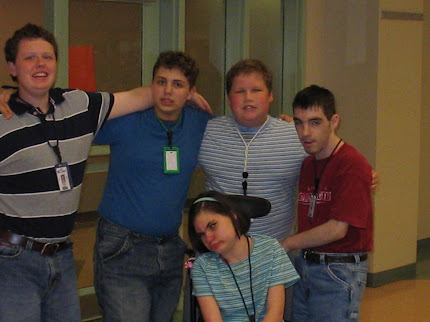
It came off my email .... Richard below is the story. Please let me know if I got anything wrong. Ihave used several pictures that I took with the names of students and also one from the picnic and one with the student in a canoe. Again, Is it ok touse the photos and names of the students? I used photos of Geoffrey, Ashley,Austin, and Jessica. Let me know. Good Luck! Suzie Smith Special education teacher wants more for students Jefferson County Education Association member Richard Reynolds is on a mission, one that he hopes will garner the necessary funds to transform hisclassroom into one that better meets the needs of the special educationstudents at Clay-Chalkville High School.This is Reynolds¹ first year at the school and he has been very busy, along with the paraprofessionals assigned to his classroom, making sure that his students are ³experiencing new horizons.² He began the year by taking the 11 students in his class, who have a wide range of special needs, on fieldtrips to learn aquatic safety at Camp Coleman and canoeing at Oak Mountain State Park.Though Reynolds is proud that he could take his students outside the classroom, he really wants to offer them more opportunities in the classroom to learn life skills. He has great ideas, but no funds to make his classroom suitable to offer life skills training and this is his mission.His classroom now features a couch and rug that he brought from home tooffer his students a cozy place to read. But he wants to rejuvenate his classroom to include a kitchen area with a sink, stove, refrigerator,microwave, dishwasher, and a washer and dryer.He also wants an assistive-technology computer center including softwarethat can pinpoint the specific needs of each student while tailoring each lesson to a particular student¹s learning style.His plans also include a wheelchair compatible work area in the classroom for art projects. ³Even though we have a small number of students, the severity of their disabilities, the wide range of their reading levels, and their different learning styles would be much better served with the assistive-computer technology,² Reynolds said.To reach his goal for his classroom, Reynolds has embarked on a constant and steady plan of pursuing every grant he hears about that might help in his quest to raise $18,000 to make the changes in the classroom.³A student might enter my classroom around age 14 and stay in my room until age 21 before they must leave the school,² said Reynolds. ³During that time they need to learn their phonics, writing, and math, but if these years are to be beneficial they must also be accompanied by life skills such as cooking, cleaning, washing clothes, and personal finance. That¹s why I am on a quest to secure grants to transform the classroom into a place that offers centers for students to learn life skills in addition to their academic work,² Reynolds said.According to Reynolds, ³These students need to experience a practical application daily through the living skills kitchen center where they can make the needed strides to hopefully become somewhat independent when they leave this school. We will not truly be able to measure effectiveness until after the students have transitioned to life after the school years and see how successful they are in becoming independent and working.²So far this year Reynolds has applied for more than 15 grants from a variety of organizations and other grant funding sources including a proposal that he sent to the producers of Extreme Makeover Home Edition. He anxiously checks his mail every day. If you have a place that you know of that works with the community to fund projects through grants or donations please let me know. Many times a business or corporation where a person works will give special consideration to a grant proposal because of an employee's family involvement. Also many offerings of assistance are never told to the public and are only known by the workers of an establishment. I am willing to write and apply for the needed financial assistance to gain technology, instructional materials and other items but to provide the opportunities that these students need we must be aggressive in seeking out funding sources. With your help we can form a team that allows us to make great strides this school year for this class of students! I believe people run marathons every day of their lives in one way or another, and we need to remember to give ourselves the finishers' medals we deserve." Zoe Koplowitz,author and marathon competitor

Autism Opportunities

7 Essential Tips For Calming Children With Autism Spectrum Disorders Let's face it, it's difficult to deal with some children with autism spectrum disorders, so that's why we need to have solutions ready at our fingertips.
1. USE ROUTINES, NOT LIP SERVICE!Set up a crystal clear, daily structure before the day begins and decrease power struggles.. Think structure, structure, structure. Why get caught in crisis at the last minute for yourself and all concerned. People, especially in the autism spectrum need routine and structure. Be pro-active and structure minded even if you're not. Learn to cut down on directing with words as you begin to chose words with careful thought and consideration and sparingly. A little goes a long way. 2. CHANGE ENVIRONMENT RATHER THAN THE CHILD!Look around you. If you actually make physical, concrete changes in your household, school, or community setting and change what needs to be changed such as location of furniture, color, lighting, clothing, chaos etc. People in the autism spectrum are especially sensitive to sensory conditions such as sound, lighting, physical touch and so on. This way the environment rather than you dictate the rules and your child can enjoy independence this way! 3. FOLLOW THROUGH WITH FOLLOW UP…FOLLOW UP…FOLLOW UPUse your routines and rules you set in motion and then make sure they are doing what they are supposed to. By doing so, you are not the bad guy and they will have to deal with the natural consequences of their actions. With those in the autism spectrum, they respond well to follow-up as they thing in concrete terms rather than abstract ones. This can be your salvation and teaches the kids what will happen in the real world. Natural consequences can be difficult for them to comprehend therefore responses and behavior may get worse before it gets better but hang in there. 4. GROUND YOURSELF, NOT THE KIDS WITH GROUND RULES!Keep your credibility and your word with your kids. Though it's hard at times, stick-to-it-ive-ness is your key to long term success. Kids in the spectrum disorder can actually enjoy grounding and time-outs due to their egocentric nature so be careful. Use masterful logic and reason and don't let them break you down or it will break you up! 5. NEGOTIAITON ISN'T JUST FOR ADULTSWhen creating rules for your kids, do so with them, not just for them whenever possible. This way they will buy into the process and will be more likely to cooperate. The rules are great for kids with autism as it helps them stay anchored. They will also surprise you many times with their comprehension of what is actually going on. Even if they are non-verbal, this does not mean they are not understanding or communicating so get the buy in. 6. BREAK TASKS INTO SMALL CHUNKSIf you overwhelm them it's no wonder they fight back. By breaking down the tasks into do-able tasks you are ensuring their feeling of success and even raising their own self-esteem. The more they have mastery over their environment the better they will feel about themselves. This should begin as small as need be with small decisions, small responsibilities etc and work up to larger ones. When deciding on the type of task to complete, try to use the seemingly insignificant activities that fill each child's day. When working with people in this spectrum, life skills are very important to integrate at an early age. Social stories and visual cues can be quite helpful as a reminder. You can place pictures and/or text on a place they normally see so they can easily access this. Its good to put words next to pictures so they can learn to associate the meaning. 7. GIVE KIDS THE "HEAD OF THE TABLE"Let them be in charge of their responsibilities though its tempting to try and avoid taking over the responsibility. In the short term it may seem easier but that's only if you want to continue doing this for them, in the case of parenting, when they are over 20! They can be rather convincing, none-the-less, hang in there. You can balance your decision to give the responsibility back by maintaining a supportive and caring attitude rather than being the bad guy! WATCH FOR MORE TIPS TO COME SOON http://www.autismtoday.com/tips.htm

Thursday, October 25, 2007

Adversity?

Adversity? Adversity has become a buzz word in the Sports world today. Listen to any broadcaster, sports talk show or coach for any length of time and eventually you will hear how the word , “:adversity.” A few years ago when Kevin Winslow was playing for the University of Miami and used the analogy of the football game being like “going to war” he was ridiculed by individuals in the media from every segment of the country from coast to coast. Yet we hear how a team learned about adversity by coming back from being two touchdowns down in the forth quarter. When the Boston Red Sox were down and trailing the Cleveland Indians recently many of the talk shows mentioned that they overcame “adversity” and therefore learned character which gives them an advantage in the World Series. Listen to ESPN, CBS, FOX or local radio talk show host and you will hear this word being used in relationship to something happening during a game. Cries should cry out from shore to shore that this is not adversity! This is a perversion of the word! Adversity LT is finding out is not starting out the season loosing or not running for a hundred yards in a game with the San Diego Chargers but is waking up and being evacuated from your home because of a Wild Fire that is out of control! Real adversity is the Tight End recently injured for the Buffalo B ills that is dealing with the possibility of not being able to ever walk again after an injury during a recent game. Adversity is not Kurt Schilling dealing with a bloody sock in a World Series or any other numerous Sports events that are now related to the word even to the point that is becoming synonymous with the word! Adversity is known by the woman and her family that is in the process of fighting breast cancer. Adversity is known by the family that is learning first hand this year what the word “downsize” means because after many years of productive service to a company now a steady paycheck has become a distant memory. Adversity is the mother attempting to raise a family when the father has decided that he really only wanted to donate a chromosome and now does not want to do the rest that goes along with what it takes to go from fathering to being a “dad”. Adversity is known by the Parents sitting in Children’s Hospital knowing that no matter how much they would like to help their child overcome their sickness that they are absolutely helpless and all they can do is to stand by watching and praying! As the Baseball season comes to an end with the World Series and Football is beginning to get to the series time of the BCS, High School Play Offs and the Pro Teams are beginning to say that every game is critical realize that adversity when correctly used is so much more than a Sporting Event. During this time of the year is when we turn to think of the Holidays and we should think of those that are truly experiencing the harshness of adversity of life every day. Then get your class at school, your civic organization, your church or as an individual to becoming involved during this Holiday Season in helping making someone’s adversity that they are experiencing being just a little bit less. Help make the day of a widow…become a Big Brother/Big Sister…give a helping hand to someone out of work…being willing to help a class at a local school even though you do not have a child or all your children are grown…in some way or another dedicate yourself to opening your eyes to noticing true cases of adversity and becoming a person that is willing to do something about the adversity that people in our community are experiencing. Even though we have a great community there are always people that are experiencing adversity. If Auburn or Alabama was down two touchdowns any Saturday we would want them to overcome adversity and win! We should be that passionate about helping the members of our community this Holiday season and around the year in overcoming the true adversity of life!

What makes this blog worth your time?

"Providing Opportunities" is a blog that will be worth your while to browse at least once a week for ideas that might work for you as you seek to better the world for the youth of t0day. As you check this blog you will find out information about this class that will inspire you, inform you and may give you ideas. This blog will be different in that if ideas are given as as a post and they seem to warrant letting others know about them then they will be posted with credit given for the source. Stephen Covey the famous author stressed the idea of "synergy" and those accomplishing more together than working seperately. This blog can accomplish synergy which provides a resource which Dr. Harry Wong states is the best way for any teacher to learn which is to "steal ideas" from other teachers and use them. "Providing Opportunities" can only work if others will submit their ideas that they have either used or seen used that worked.
add'>http://technorati.com/faves?sub=addfavbtn&add=http://providingopportunities.blogspot.com>Add to Technorati Favorites
View blog authority
Technorati Chart

Making a difference today...will provide a better tommorrow!

Making a difference today...will provide a better tommorrow!
Providing Opportunities today changes a tommorrow!